Discounted Cashflow Model
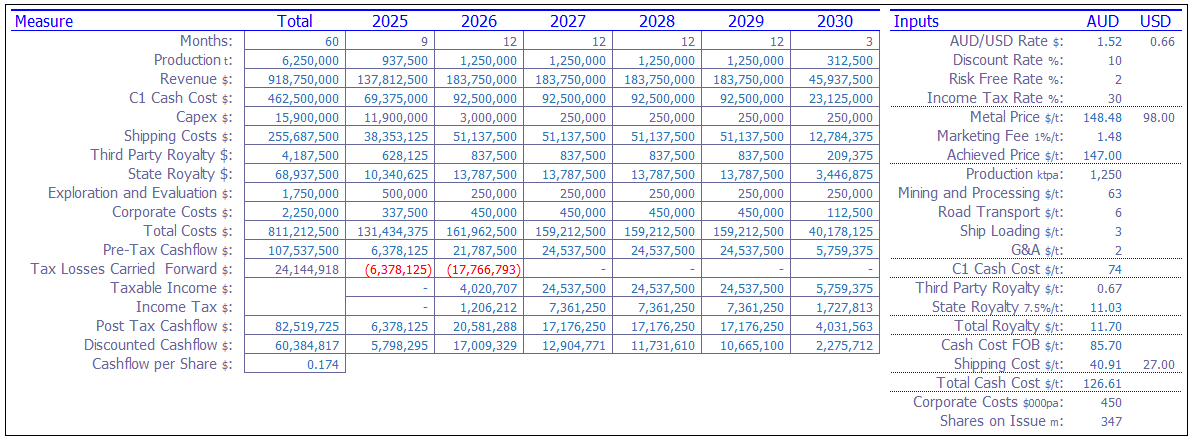
The above model demonstrates the projected
cashflows from a mining operation with an estimated life of mine of five years.
The mine is expected to commence
production in the second quarter of 2025 and generate a life of mine, post-tax
cashflow of AUD$83 million, using an effective tax rate of 30%.
This cashflow is then discounted to a NPV
- Net Present Value - of AUD$60 million, using a discount rate of 10%.
This should generate 17.4 cents per
share for a company with 347 million shares on issue.
NPV
- Net Present Value
It is generally accepted that NPV is
best practice when analysing any investment decision. This is because it
considers the time value of money – a dollar today is worth more than a dollar received in the
future – due to inflation, risk and liquidity.
The key inputs to
the NPV calculation are the cashflows, the timing of the cashflows and the discount rate.
Discount
Rate
The discount rate is
usually modelled using WACC –
Weighted Average Cost of
Capital – adjusted for inflation, risk and liquidity.
Another method for
calculating the discount rate is to use the Cost of Equity. This
measure may be considered superior to WACC because it does not consider the
cost of debt.
It
is worth noting that the lower the discount rate used, the higher the resulting
NPV. This specifically relates to the discount rate used in a DFS - Definitive
Feasibility Study or a PEA - Preliminary Economic Assessment.